
Disciples in training.
Wednesday, March 4, 2009

Inequality and Society
The Economist magazine has a review of a book, released in January in Britain, that analyzes links between social health (e.g., crime) and inequality. Specifically they critique the notion that the desire for economic growth should trump the desire for wealth distribution. The book has only been released in Britain thusfar, but when it comes to the US, we'll offer a review.
The Spirit Level: Why More Equal Societies Almost Always Do Better (Hardcover)
by Richard Wilkinson (Author), Kate Pickett (Author)
Wednesday, February 25, 2009
Supper
Concrete came by my place a couple times last week for supper. He does this a few times a week, just stopping in when he is cold or hungry or needs to get away from the other guys. I made him some pork chops I had gotten out for such an occasion and he exclaimed about how good they are. The second time he came I wasn't around but Lisa made him the remaining chop, for which he was grateful. But what he really wanted, he said, was spaghetti. "I'm trying to get you to make up a big bunch of spaghetti", he said the next day. "Lots of meat and green peppers, red peppers, yellow peppers, orange peppers, in a big pot."
So the next night I dragged my wife and a couple of my catechumens with me and we all made a bunch of spaghetti in the church kitchen, complete with as many different colored peppers as we could find. I had been conflicted about whether to make it at the church so all the Guys could partake or to make it at home where Crete could warm up while he ate (he doesn't go inside churches). When I asked Crete what he'd prefer I was told (as I should have known) "I don't run nothin'."
We pulled the picnic tables under the covered walkway and, along with a bunch of other Guys, all ate outside in the cold with Crete (I usually don't insist on this, but I did this time). Joel and Kenetta did a great job with the food and everybody ate a lot. Most of the Guys packed up a plate or two and took it back to the Hill where the fire was keeping them warm. But a few cold souls ate at the table. Sarah gave Sammie as much petting as she wanted and Joel chatted up Howard, Crete and Eddie over at the other table. Trevor kept Gail company inside and was helpful as usual cleaning things up.
I hope Concrete knows by these tiny gestures we sometimes make how much he means to us and that he can see that our lives have been changed by his presence. Of course, such a wish falsely presumes that he is as self-centered as I am.
Monday, February 23, 2009
Poverty Porn
An above average treatment of the issue of poverty, especially as it relates to making others rich, can be found here.

Saturday, February 21, 2009
Incorporating Individuals
Willette said to me on Thursday evening after prayer, "Thank you for this service. Now maybe I'll make it through the week." I must admit that I was a little surprised by the comment. Willette comes to EP rather often, so it is not as if she just happened by in a moment of spiritual necessity and found the requisite manna from heaven. She was thanking us for being present, for opening the church, and for leading the office. Her statement made me think, and still has me pondering. I wonder if it has not revealed some of my own myopia and even selfishness.
I wrote about presence in a post for the blog a long while ago. The essence of that piece was the importance of constancy and physical presence, day in, day out. But that piece also focused on how our presence for the office brought us in communion with the homeless, and how the constancy of that presence was the foundation for us all to be transformed through friendship with one another. In that vein I think we have come to stress the office in two main ways: (1) as a fundamental part of the day, as routine and necessary as brushing one's teeth, and (2) as a practice that, through its mere observance, will transform us in spite of ourselves as, for example, in bringing us in contact with the poor. These two emphases have, for me, become slightly pathological in that the emphasis seems to be on me. The office is something that I need to do, day in and day out (literally through MP and EP), and it is something that will transform me. What is lost in this pathology is the notion of liturgy as "work of the people" and the realization of the office as an extension of the Eucharist. It seems that I have found an encroachment of individualism even in the commitment to corporate worship.
Willette reminded me of this because I often lead the office with a rather perfunctory attitude (much as I might brush my teeth), sometimes even as a chore that needs be done. It's not a glorifying admission, but true. Willette comes, as I expect Shirley does too, in part to step into the Kingdom for a few minutes during the week and find refreshment. Willette has challenged me, albeit unintentionally, to see the office now also as part of the preparation of the altar for Sunday -- we are an altar guild of sorts. We gather morning and evening to bring the cares and anxieties of the world into the congregation, piling them upon the altar. On Sunday Christ's body will be broken, and with it the altar will be cleansed and renewed. We are, in a way, sanctifying this world by faithfully gathering its sins and bringing them to the altar.
This is to say that while we are being transformed by stamping the time-card, by just being present, we are also making Christ's presence real during the week for all who need him -- not in the way that the priest makes Him present at Sunday mass, but as the priest has already made Him present and presented Him to us, forming us into the Body. The office is part of the preparation for Sunday, but equally it is part of Christ's presence to His people. It bears all the marks of the already and the not yet.
It is worth bearing this in mind (even if this is mostly a self-referential meditation). When we gather during the week we are doing more than we know, making God present in the world. The presence we offer is not just to the guys but to Onye and Willette and Shirley and everyone else who is weary and heavy laden (myself included). We come to the office to be in the presence of God, to sit at the Trinitarian banquet, and so our participation in the office should bear all the care and attention with which we come to the Eucharist. For even as we seek sustenance, by doing so-- by seeking faithfully-- we also create a space in this world where the finding is possible for those around us. We say the office not just that we may find transformation but that we may offer it through our service, "always carrying in the body the death of Jesus, so that the life of Jesus may also be made visible in our bodies."
So, it should be no surprise to me that those who attend only episodically or even only once may be blessed by the office. The office is a liturgical reminder and enactment of Psalm 121, fulfilling the daily cycle: "The Lord shall watch over your going out and your coming in, from this time forth for evermore." The office is in part a sacramental sign of Christ's enduring faithfulness -- that He will be present and available bodily -- that "He who watches over you will not fall asleep."
Willette's statement should be no surprise, but I had lost sight of what we were doing.
It is worth bearing this in mind (even if this is mostly a self-referential meditation). When we gather during the week we are doing more than we know, making God present in the world. The presence we offer is not just to the guys but to Onye and Willette and Shirley and everyone else who is weary and heavy laden (myself included). We come to the office to be in the presence of God, to sit at the Trinitarian banquet, and so our participation in the office should bear all the care and attention with which we come to the Eucharist. For even as we seek sustenance, by doing so-- by seeking faithfully-- we also create a space in this world where the finding is possible for those around us. We say the office not just that we may find transformation but that we may offer it through our service, "always carrying in the body the death of Jesus, so that the life of Jesus may also be made visible in our bodies."
So, it should be no surprise to me that those who attend only episodically or even only once may be blessed by the office. The office is a liturgical reminder and enactment of Psalm 121, fulfilling the daily cycle: "The Lord shall watch over your going out and your coming in, from this time forth for evermore." The office is in part a sacramental sign of Christ's enduring faithfulness -- that He will be present and available bodily -- that "He who watches over you will not fall asleep."
Willette's statement should be no surprise, but I had lost sight of what we were doing.
Thursday, February 19, 2009
Giving to Him Who Begs
Today when I arrived for morning prayer I noticed a well-dressed young man, probably in his early 30's, that I had not seen before. He worked his way through prayer with us (as he was not familiar with the BCP), and exchanged the peace afterwards. As everyone finished exchanging the peace he introduced himself as a pastor and approached C saying that he was in a bit of a tough spot. He had a flat tire on his vehicle. A local man was replacing the tire, but the pastor had only half the necessary money to pay for the replacement, which would cost approximately $120. Could we help him?
C offered him whatever was in the poor plate at the back of the church. On this particular morning that amounted to about $10. I volunteered to go across the street to the bank and withdraw some money to make up the difference. I doubted that I had enough in the bank to cover the full difference, but I was willing to contribute whatever was there.
As it turned out I had enough money in the account to give him $60 to cover the other half of the cost of the new tire. When I handed over the money to Pastor D he asked if we were at the church every morning. We replied that we were, and he followed by saying that he would be back tomorrow to reimburse me.
At breakfast C admitted that he was a little scandalized by my giving the man $60. I admitted that I was too but that it hadn't fully hit me yet. I just gave away $60 to a stranger. Why? Or, as my wife would put it: Why!?! C, A, and I were all reasonably confident that I would never be reimbursed as the man had promised. This is a self-conscious skepticism on our part, born of being conned and lied to repeatedly. So, why did I give this man the money if I was skeptical of his honesty, and especially when the request was for so much?
An oft overlooked passage spoken by Jesus is "Give to everyone who begs of you, and do not refuse anyone who wants to borrow from you." (Matt. 5:42) What do you do with an exhortation like that? Does Jesus really mean "everyone"? Does he not mean something a little more restricted, perhaps "give to all Christians" or all "decent folk", or to all those whom you have no reason to believe are lying?
Matthew 5:21-48 consists of a series of expositions in the format "You have heard it said... But I say..." So, before we put caveats on the exhortation to give to everyone who begs, consider that the exhortation comes on the heals of "You have heard it said, 'An eye for an eye and a tooth for a tooth'. But I say to you, do not resist an evildoer."(v38-39) Jesus tells us not to resist the evildoer and then in the same rhetorical unit exhorts us to give to everyone who begs. The implication seems plain: Do not offer evil in return for evil; to him who asks of you out of greed, respond to him from your charity.
The scandal of this passage is that Jesus implies that "being reasonable" about giving, to deny the gift when it is a poor investment or the recipient is not virtuous, is to return evil for evil. It is to return the beggar's sinfulness in asking with my lack of charity.
If I thought that I could get out of this scandal by suggesting that Jesus' exhortation was not a part of the "eye for an eye" reversal but perhaps the one following, I find no help. For the one following is "love your enemies". The exhortation to give is sandwiched between expectations of the agency of evildoers. We might abbreviate the passage:
Do not resist the evildoer. Give to everyone who begs of you. Love your enemies.
Jesus cannot be called naive in his exhortation to give freely. He explicitly locates his exhortation in the context of sinful world full of evil requests. And yet he says to us that giving freely of ourselves is the way to take up his yoke. We are not called to control this world, but to offer ourselves as living members of Christ, who is love, and who poured himself out for us.
There is a part of me that is still shocked that I gave away $60 dollars this morning with little or no consideration of the "reasonableness" of doing so. But I don't see that I had many options if my actions are to be accountable to Christ.
And tomorrow, if Pastor D returns with $60 to reimburse me, then I will have to confess my lack of trust that he would do so. My giving is still incomplete, because through skepticism I did not realize Godly love in the transaction.
As it turned out I had enough money in the account to give him $60 to cover the other half of the cost of the new tire. When I handed over the money to Pastor D he asked if we were at the church every morning. We replied that we were, and he followed by saying that he would be back tomorrow to reimburse me.
At breakfast C admitted that he was a little scandalized by my giving the man $60. I admitted that I was too but that it hadn't fully hit me yet. I just gave away $60 to a stranger. Why? Or, as my wife would put it: Why!?! C, A, and I were all reasonably confident that I would never be reimbursed as the man had promised. This is a self-conscious skepticism on our part, born of being conned and lied to repeatedly. So, why did I give this man the money if I was skeptical of his honesty, and especially when the request was for so much?
An oft overlooked passage spoken by Jesus is "Give to everyone who begs of you, and do not refuse anyone who wants to borrow from you." (Matt. 5:42) What do you do with an exhortation like that? Does Jesus really mean "everyone"? Does he not mean something a little more restricted, perhaps "give to all Christians" or all "decent folk", or to all those whom you have no reason to believe are lying?
Matthew 5:21-48 consists of a series of expositions in the format "You have heard it said... But I say..." So, before we put caveats on the exhortation to give to everyone who begs, consider that the exhortation comes on the heals of "You have heard it said, 'An eye for an eye and a tooth for a tooth'. But I say to you, do not resist an evildoer."(v38-39) Jesus tells us not to resist the evildoer and then in the same rhetorical unit exhorts us to give to everyone who begs. The implication seems plain: Do not offer evil in return for evil; to him who asks of you out of greed, respond to him from your charity.
The scandal of this passage is that Jesus implies that "being reasonable" about giving, to deny the gift when it is a poor investment or the recipient is not virtuous, is to return evil for evil. It is to return the beggar's sinfulness in asking with my lack of charity.
If I thought that I could get out of this scandal by suggesting that Jesus' exhortation was not a part of the "eye for an eye" reversal but perhaps the one following, I find no help. For the one following is "love your enemies". The exhortation to give is sandwiched between expectations of the agency of evildoers. We might abbreviate the passage:
Do not resist the evildoer. Give to everyone who begs of you. Love your enemies.
Jesus cannot be called naive in his exhortation to give freely. He explicitly locates his exhortation in the context of sinful world full of evil requests. And yet he says to us that giving freely of ourselves is the way to take up his yoke. We are not called to control this world, but to offer ourselves as living members of Christ, who is love, and who poured himself out for us.
There is a part of me that is still shocked that I gave away $60 dollars this morning with little or no consideration of the "reasonableness" of doing so. But I don't see that I had many options if my actions are to be accountable to Christ.
And tomorrow, if Pastor D returns with $60 to reimburse me, then I will have to confess my lack of trust that he would do so. My giving is still incomplete, because through skepticism I did not realize Godly love in the transaction.
Saturday, February 14, 2009
Breakfast
Breakfast as usual this last week. Friday Joel and Sarah came to Morning Prayer and then over with us to eat. I suspect that they come because i make them - they are part of the Catechesis class at St Joes and have voluntarily committed to coming to the Office and serving the poor once a week - but they never seem too put out about it.

After a few minutes C and E came in for a bite. We talked about dogs for a while. Sammie my dog is always at prayer and so if conversation runs dry we can always talk about her. She loves most of the guys but especially E, since he is wont to give her a little of what is on his plate. C told us about the program he is in in Chapel Hill to try to get hooked up with transitional housing. So he is bussing up and down the eight miles three or five days a week to go to meetings with various folk. He complains that the staff is all volunteer and so they often don't show up. He also relates story after story about why "he hates cops". "I don't want to hate anybody", he says, "but I just can't help it." He told us one story about standing at the bus stop waiting for a bus and being told that he couldn't loiter. "I'm waiting for the bus", he protested, "along with all these other folk." But the cop knew him as a homeless man and made him move off the sidewalk to a bit of dirt beside one of the buildings. They police the homeless so tirelessly in Chapel Hill, C says, that most of the guys he knows come up to Durham. But even in Durham, he says, if the police don't like you, or don't like the homeless in general, they can make life hell. One guy consistently calls them "cockroaches", apparently.
T was quiet and well mannered as usual. Earlier this week he went over to Whole Foods and got us some cereal when we were running low. This man's generosity and faithfulness amazes me. He mentioned that he just managed to rent a room somewhere across town and he was worried that the couple he rented it from were - for some reason - going to be arrested. Barely enough money to get himself a sub-par room he still shows up for prayer, Eucharist and Bible Study, and insists upon contributing to the needs of the saints week after week, day by day.
Thursday, February 12, 2009
Because the Real Reason to Help the Poor...
...is that it is a boost to the economy. See the story here.
Please forgive the sarcastic cynicism, but perhaps the poor would be better served if the relationship of poverty to our capitalist economy could properly be named as being of an entirely different sort. At any rate, it's nice to see that altruism (on behalf of the economy, of course) is on the rise.
Tuesday, February 3, 2009
What's In a Name?
Lately I have been wondering what it means for us to use the word "homeless" in reference to a particular person or group of persons. It's a linguistic practice I engage in all the time but one to which I have paid little sustained attention. For example, in conversations with my wife I will frequently refer to the "homeless" or "our homeless friends" at St. Joe's. And I suspect that, like me, most of us think nothing of using "homeless" as an indexical marker, a sortal by which to name a person or persons. However, it occurred to me today that, as a primary means of distinction, this readily available and handy denominator, while presumably applicable in the majority of cases it is used, is nevertheless perhaps not the most charitable descriptor available for our use.
For starters, the use of the adjective "homeless" as a primary designator opens subtle but no less insidious possibilities for the individual and collective exploitation of the already oppressively subjugated. After all, there's no glory (and thus, little point) in relaying to a colleague that I happen to have breakfast with some guys from my church every morning. But to mention that I daily share a breakfast table with the homeless, well, that's a much more personally advantageous way to tell the story! In such a case, my breakfast companions' plight can quite easily become my profit simply by use of that two-syllable word, "homeless." Indeed, by employing that otherwise seemingly harmless term, a great deal of social capital can be had at the expense of those with little to no capital whatsoever.
Secondly, and more reflexively, I think it is worth asking the question as to whether or not I would like to be identified primarily through descriptors the possibility for the rightful application of which I would be less than enthused to have so highlighted. What would it be like for the generally perceived "negative" features of my daily existence to be raised to the level of a primary marker? "Oh, there's Adam, my lazy friend." "Hi, I'd like you to meet my unjustifiably self-satisfied buddy, Adam." "Let me tell you what my unreasonably rotund friend from church did the other day." How many of us would like to be so denominated? Though ostensibly innocuous, I would imagine a less potentially damaging means of identification could be conjured than "homeless." I certainly have difficulty conceiving a scenario wherein I would be comfortable referring to my friend W primarily by the term "homeless" while in W's presence. What, then, does that say about how I use the term?
Thirdly, and on the topic of identification, how might the use of the word "homeless" as a frequently recurrent signfier promote the creation of a static and behaviorally short-circuiting identity among those so named? Here I have in mind friends whose various inclinations (imagined or otherwise) have, through externally generated reinforcement, become their primary (and often sole) means of self-description such that they cannot conceive of themselves apart from those descriptive terms. If one grows up in a home, for example, where one is called "stupid" with any significant frequency, it often becomes painfully difficult to imagine oneself in any other terms, effectively trapping such a one in an unnecessarily generated prison of identity. "Homeless" could thus function, not as a description of one's current domestic circumstance, but as an integral (metaphysical) feature of who one is. Yet, how would/could such a one ever begin to think of themselves any differently after having been (repeatedly and reinforcingly) so damned?
Lastly, I wonder how much the primary use of "homeless" as an indexical term is a function of our desire to create distance between our bourgeois selves and these, the phenomenologically "other". To what degree does "homeless", as a fundamental category, quarantine the terrifying possibility that we might otherwise be confronted with an actual person whose naked and common humanity, freed from all externally imposed, carefully constructed, and calculatedly constraining labels, might be seen to have legitimate claim on our lives and possessions? What kind of buffer or boundary does "homeless", as a primary designator, create for we who are apt to use it? At the very least, I wonder what it would be like if I discovered that "the homeless" folks with whom I share breakfast primarily referred to my friends and I as "the homed." What would the use of such a label, the differential grammar of which is rooted in economic class/status, do to my understanding of the nature of our relationship or their perception of me as a (classed) person?
I must confess that I don't have much to offer by way of an answer or linguistic replacement (recall that the above is merely a reflection on my own deeply ingrained - and potentially bad - linguistic habits). Really, all I intend to accomplish at this juncture is the raising of a question. And, indeed, perhaps a case can be made for the continued use of "homeless" in the signifying capacity I have described above. But, for the time being, I think that the question is worth asking and our linguistic practices with respect to "the homeless" we encounter worth evaluating. Minimally, can we not envision a more intentional and charitable means of reference to these, the embodiment of Christ's person made present?
Widow's Mite
There is a man, T, who lives in his truck in the church parking lot. He has been around St. Joe's now for a good while - perhaps a year. At first I didn't think he was homeless. He would come to HE on Sunday and stick around for coffee hour to chat. He never asked for anything.
Since taking up residence at the church he has rarely missed a service of Communion or Daily Prayer. He comes to breakfast, sometimes eating and sometimes not (I think it depends on what the casserole looks like), but always politely conversing. I've never seen him drink, though he seems to be on good terms with the others at church that do. T is one of the folks that makes the work we do easy and joyful.
This morning T and I said prayer together, just the two of us, for the first 15 minutes of the service. As we were leaving prayer, a woman who had arrived in time for the last few prayer asked for a bus pass to go job hunting. I said I would have to try to get one for her today because I was out. Then I turned around to the poor plate to see if I could fish the two dollars for the pass out of it. Before I could do so, T had opened his wallet, pulled out two dollars and given them to her.
I smiled in awe of the beauty.
I hung my head half-comically at my hardness of heart. I had been inclined to wait and see if I could get someone to pick up some passes later that day. That would cost me nothing. Then I had turned to the $60 in the poor plate to see if there were a couple of singles. Administering the poor plate costs me nothing, and by it I gain recognition for "serving" the poor. And it is mostly filled by those giving out of their abundance. The poor plate usually costs its donors nothing.
But T had given out of his lack. Such a gift was costly and it must have hurt. With all the cash in the poor plate I could not have given more. It was a sacrifice I did not dare council against.
Monday, February 2, 2009
Expect more...
... not less patronizing and ridiculous coverage of poverty from the major news outlets. Our latest example of "simulating poverty": http://www.cnn.com/2009/LIVING/02/02/food.stamps.economy/index.html
Breakfast
Every weekday we have breakfast at the church parish hall after Morning Prayer. A couple of nice ladies from the Presbyterian church next door provide us with breakfast casseroles each week (these range from regular eggs and sausage to grits and chili and cheese and they are always a surprise). The purpose of this was originally to create a time each day when we would hang out with our homeless and poor friends, and not just co-exist in the same space with them.
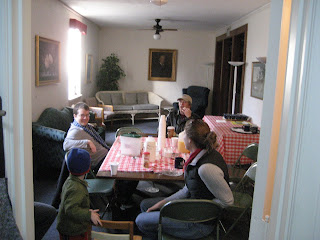
There are usually at least two of us from the MP congregation that stay and eat. At least half the time one of the men brings his three year old son. The lad was originally shy of the homeless but once last month he expressed his displeasure when no one had yet come in to the table. Sometimes we are joined by a catechumen from the church who is required to serve the poor once a week.
The number of people that actually come in off the street varies from morning to morning, depending on a number of variables like temperature and how much they had to drink last night. This morning we had four poor friends (two of which are also catechumens and have recently moved into a room together but they make a point to come the two miles across town to eat), one catechumen, and four members of the congregation.
Y was particularly happy this morning to have passed her state exam to be a Certified Nursing Assistant. She printed out her resume on the computer so she could go over to Duke Hospital and apply for a job. W came in to eat, having been happier to sleep on his cardboard in the walkway than to stay at the hotel his friends had offered him. He didn't have his hat on and his graying hair reminded me that being on the street is harder for him than his casual, placid, if slurred, speech would let on.
As usual, breakfast lasted about 45 minutes and all were full and caffeinated and ready to move onto whatever the day held for them.
Sunday, February 1, 2009
Poverty as Conscientious Objection
Our whole modern economy is based on preparation for war and that is one of the great modern arguments for poverty. If the comfort one had gained has resulted in the death of thousands in Korea and other parts of the world, then that comfort will have to be atoned for. The argument now is that there is no civilian population, that all are involved in the war (misnamed defense) effort. If you work in a textile mill making cloth, or in a factory making dungarees or blankets, it is still tied up with war. If one raises food or irrigates to raise food one may be feeding troops or liberating others to serve as troops. If you ride a bus you are paying taxes. Whatever you buy is taxed so you are supporting the state in the war, which is "the health of the state," exactly to the extent of your attachment to worldly things of whatever kind.
[Day, CW, April 1953]
Thursday, January 29, 2009
John Wesley to Miss J.C. March
Here are a couple of excerpts from letters from John Wesley to a Miss March, a woman of "wealth and education". When Miss March admitted her struggles with the fact that associating with Methodists also meant she came into contact with the poor, Wesley wrote to her:
"Go and see the poor and sick in their own poor little hovels. Take up your cross, woman! Remember the faith! Jesus went before you, and will go with you. Put off the gentlewoman; you bear an higher character. You are an heir of God and joint-heir with Christ! Are you not going to meet Him in the air with ten thousand of His saints? O be ready!"
She complains of associating with people of poor taste and low character..., and Wesley replies:
"I want you to converse more, abundantly more, with the poorest of the people, who, if they have not taste, have souls, which you may forward in their way to heaven. And they have (many of them) faith and the love of God in a larger measure than any persons I know."
To her continued protest he writes:
"What I advise you to is, not to contract a friendship or even acquaintance with poor, inelegant, uneducated persons, but frequently, nay constantly, to visit the poor, the widow, the sick, the fatherless in their affliction; and this, although they should have nothing to recommend them but that they are bought with the blood of Christ. It is true this is not pleasing to flesh and blood. There are a thousand circumstances usually attending it which shock the delicacy of our nature, or rather of our education. But yet the blessing which follows this labour of love will more than balance the cross."
Miss March replies saying to this exhortation to "constantly" visit the poor that she is already a busy woman and that some time must necessarily be put aside for seclusion and prayer in the maintenance of her spiritual life. To this, Wesley:
"Yet I find time to visit the sick and the poor; and I must do it, if I believe the Bible, if I believe these are the marks whereby the Shepherd of Israel will know and judge His sheep at the great day...
... and I am concerned for you; I am sorry you should be content with lower degrees of usefulness and holiness than you are called to."
-selections taken from the essay "Visit the Poor: John Wesley, the Poor, and the Sanctification of Believers" in The Poor and the People Called Methodists, ed. Richard Heitzenrater.
Wednesday, January 28, 2009
On Grace
Unless I am convinced otherwise by my Augustinian friends, this reading from St. Chrysostom, appointed in Celebrating the Saints on the Feast of Ss. Timothy and Titus, goes for me.
Paul's words remind us that much zeal is required to stir up the grace of God in us. Just as a fire requires fuel, so grace requires our glad and willing consent if it is to be fervent. For it lies within our power to kindle or extinguish the grace of God in each of us. That is why Paul admonishes us: "Do not quench the Spirit!" The Spirit is quenched by sloth and carelessness, but kept alive by being watchful and diligent. As Paul goes on to say: "God did not give us a Spirit of fear, but rather a Spirit of love and of self-discipline." In other words, we have not received the Spirit that we should not need to make any effort in life, but rather that we may speak with boldness. But to us God has given a Spirit of power and of love for himself. This is the work of grace, and yet not only of grace: we too have a part to play. For the same Spirit that makes us cry out "Abba, Father!" inspires us with love both for God and for our neighbor, that we may love one another.
[In Praise of St. Paul, PG 52.427-30]
Sunday, January 25, 2009
Chrysostom on the Practicality of Prayer
"Do you not know that if you come and worship God and take part in the work which goes on here, the business you have on hand is made much easier for you? Have you worldly anxieties? Come here on that account that by the time you spend here you may win for yourself the favour of God, and so depart with a sense of security; that you may have Him for your ally, that you may become invincible to the dæmons because you are assisted by the heavenly hand. If you have the benefit of prayers uttered by the fathers, if you take part in common prayer, if you listen to the divine oracles, if you win for yourself the aid of God, if, armed with these weapons, you then go forth, not even the devil himself will be able henceforth to look you in the face, much less wicked men who are eager to insult and malign you. But if you go from your house to the market place, and are found destitute of these weapons, you will be easily mastered by all who insult you. This is the reason why both in public and private affairs, many things occur contrary to our expectation, because we have not been diligent about spiritual things in the first place, and secondarily about the secular, but have inverted the order. For this reason also the proper sequence and right arrangement of things has been upset, and all our affairs are full of much confusion." - St. John Chrysostom, from the homily on "If thy enemy hunger, feed him."
Friday, January 23, 2009
Love and the Poor: A Personal Reflection
I have said elsewhere that the only positive thing that we do at St. Joseph's is decline the temptation to exclude the homeless from fellowship. In that sense we have only made the most basic step toward community, which is not to preclude its possibility. Now we have, in a way, moved on. We have long since invited the poor among us, or perhaps we have responded to their invitations - after all, they have been there longer than most of us. But having avoided the first temptation to undermine community, moving ever toward the eucharistic ideal, we are faced with new challenges.
The challenges, I have thought at times, are those of discerning the deserving from the undeserving, or perhaps of convincing my new friends that I am not to be conned, or to establish a level of understanding with them concerning what I can and cannot give, or will and will not. These challenges, it turns out, are all the challenges of maintaining control. The first is to control the reception of my charity, that it not be taken for granted or squandered when others could use it more. The second is control of my dignity. The third is control over the claims that the poor might make of me, as if to say, "I'll give you anything as long as you don't ask for this, or that."
The fear of losing control is at once a fear of "enabling" or perpetuating sin (by giving money to an alcoholic in search of a drink), of being made a fool in a con, or of the slippery slope that one seems to occupy when one starts giving freely to those who ask (because so few exercise proper restraint in asking!). It is clear that these are fears that I face. And yet the fear of enabling rests on a conviction that I am a more responsible steward than the alcoholic, perhaps that spending that money on my own dining-out habits, on coffee for a meeting with a colleague, is somehow more faithful than this man's indulgence in a destructive habit born of who knows what hardship. The fear of being made a fool is a fear of losing the esteem of others, and ultimately a fear of being made lowly, even if it be for the sake of Christ. The fear of the slippery slope is ultimately a fear of becoming poor. And the fear of becoming poor is the fear that God will not provide what I need. The belief that through charity one might be left with too little is fundamentally a failure of faith.
Once I realize that what I thought were the challenges are really no more than my own habits to distance myself from the poor, or even from others generally, I begin to have some idea of greater challenges. The greater challenge as I see it is to see Christ in the undeserving, the needy, the down-trodden. To see a man or woman who is so battered to the point of self-loathing is to see an immensely unattractive person. But Isaiah gave a foretaste of this:
He had no beauty or majesty to attract us to him,
nothing in his appearance that we should desire him.
He was despised and rejected by men,
a man of sorrows, and familiar with suffering.
Like one from whom men hide their faces
he was despised, and we esteemed him not…
He was despised, and we esteemed him not. Christ lives among us, as the least of these, the despised, those of little esteem, perhaps as those who have not even their own esteem. Not only is it hard to see Christ in this suffering person - for it is hard, really, to fathom that He went not up to joy but first He suffered pain - but we turn our heads from this pitiful creature perhaps because it makes a fool of us just to see it: the image of God found self-loathing and alone. It is repulsive to see the pearls cast before swine, the beloved of Christ trodden by sin, and we turn our heads in shame and disgust, and distance ourselves from the sacrilege.
But is this not the view of God from the beginning of time, to see sin mingled with his image, the goodness of creation soiled by sin? His response was not to lift himself higher, distancing himself from that which conceived in love and goodness had become tainted, but instead he lowered himself to come among us, to sit in fellowship with sinners, to have himself lifted high on a cross. The perfect image of God became incarnate, first as salvation from the power of death, but also as an example to man of the perfection of the very image in which he was created.
So then in these encounters we recognize that Christ is on both sides. We find him in the least of these, and we find him as our victory over the threats of sin and death. We no longer have anything to fear by encountering Christ in this person, and love of God demands that we raise this Christ-like figure to his proper glory, out of the muck and offal of anonymity and scorn, and into the love of Christ.
The challenges, I have decided, are not challenges intrinsic to the poor. The challenge is no more particular than learning to love another person as Christ loved us. Perhaps he gave us the poor to love in part to convince us how much deeper could be our love even for those to whom we acknowledge our closeness, our spouses and family. This is the sacramental presence of the poor, a vehicle of grace and instrument of Divine Love.
It is a challenge to love the poor not because of their poverty or their faults - not because of smells or impropriety or disease - but because we know so little of how to love in the first place, poor or otherwise.
Use of Force
Christ our Lord came and took upon Himself our humanity. He became the Son of Man. He suffered hunger and thirst and hard toil and temptation. All power was His but He wished the free love and service of men. He did not force anyone to believe. St. Paul talks of the liberty of Christ. He did not coerce anyone. He emptied Himself and became a servant. He showed the way to true leadership by coming to minister, not to be ministered unto. He set the example and we are supposed to imitate Him. We are taught that His kingdom was not of this earth. He did not need pomp and circumstance to prove Himself the Son of God. His were hard sayings, so that even His own followers did not know what he was saying, did not understand Him. It was not until after He died on the cross, it was not until He had suffered utter defeat, it would seem, and they thought their cause was lost entirely; it was not until they had persevered and prayed with all the fervor and desperation of their poor loving hearts, that they were enlightened by the Holy Spirit and knew the truth with a strength that enabled them to suffer defeat and martyrdom in their turn. They knew then that not by force of arms, by the bullet or the ballot, they would conquer. They knew and were ready to suffer defeat--to show that great love which enabled them to lay down their lives for their friends. And now the whole world is turning to "force" to conquer. Fascist and Communist alike believe that only by the shedding of blood can they achieve victory. Catholics, too, believe that suffering and the shedding of blood "must needs be" as Our Lord said to the disciples at Emmaeus. But their teaching, their hard saying is, that they must be willing to shed every drop of their own blood, and not take the blood of their brothers. They are willing to die for their faith, believing that the blood of martyrs is the seed of the Church. Our Lord said, "Destroy this temple and in three days I will raise it up." And do not His words apply not only to Him as Head of his Church but to His members? How can the Head be separated from the members? The Catholic Church cannot be destroyed in Spain or in Mexico. But we do not believe that force of arms can save it. We believe that if Our Lord were alive today he would say as He said to St. Peter, "Put up thy sword." Christians when they are seeking to defend their faith by arms, by force and violence, are like those who said to our Lord, "Come down from the Cross. If you are the Son of God, save Yourself." But Christ did not come down from the Cross. He drank to the last drop the agony of His suffering and was not part of the agony the hopelessness, the unbelief of His own disciples? Christ is being crucified today, every day. Shall we ask Him with the unbelieving world to come down from the cross? Or shall we joyfully, as His brothers, "Complete the sufferings of Christ"? And are the people to stand by and see their priests killed? That is the question that will be asked. Let them defend them with their lives, but not by taking up the sword. At a meeting of the opposition last week, when a Spanish delegate of the Loyalists told of unarmed men flinging themselves, not from principle but because they had no arms, into the teeth of the enemy to hold them back, the twenty thousand present cheered as one. In their small way, the unarmed masses, those "littlest ones" of Christ, have known what it was to lay down their lives for principle, for their fellows. In the history of the world there have been untold numbers who have laid down their lives for our Lord and His Brothers. And now the Communist is teaching that only by the use of force, only by killing our enemies, not by loving them and giving ourselves up to death, giving ourselves up to the Cross, will we conquer. If two thousand have suffered martyrdom in Spain, is that suffering atoned for by the death of the 90,000 in the Civil War? Would not those martyrs themselves have cried out against more shedding of blood? Prince of Peace, Christ our King, Christ our Brother, Christ the Son of Man, have mercy on us and give us the courage to suffer. Help us to make ourselves "a spectacle to the world and to angels and to men." Help your priests and people in Spain to share in your suffering, and in seeming defeat, giving up their lives, without doubt there will be those like the centurion, standing at the foot of the cross who will say, "Indeed these men are the sons of God." [By Dorothy Day, The Catholic Worker, November 1936; From catholicworker.org]
Entertaining Angels
Mick told me a story yesterday. Last Saturday, Gail was up at the church and a cab pulled up. Out stepped a man with some papers in his hand, and he was a wreck. Sobbing, he told her that he had just been released from the mental health facility in Butner. His papers verified this, and it was apparent, and he agreed, that he was in no shape to be released. At any rate, somehow either he or the cab driver had heard about our little church, and he had been dropped off “for us.” Gail made him a sandwich and said he was welcome to hang around. I’ve not seen this man, but this is not the first time people released from Butner have made St. Joe’s their first stop. I have no idea how they find out about us or what they expect to find when they get here. Most of the time we are singularly unprepared for them and unable to do anything other than feed them and offer them the church grounds for a place to lay their head. But it appears there is some word on the street that you can always go to This is anything but a pat on our back. If anything, it should make us aware that God is often sending his outcast our way. And I think he intends for us to care for them all. Lord, have mercy.
Love Is the Measure
We confess to being fools and wish that we were more so. In the face of the approaching atom bomb test (and discussion of widespread radioactivity is giving people more and more of an excuse to get away from the philosophy of personalism and the doctrine of free will); in the face of an approaching maritime strike; in the face of bread shortages and housing shortages; in the face of the passing of the draft extension, teen-agers included, we face the situation that there is nothing we can do for people except to love them. If the maritime strike goes on there will be no shipping of food or medicine or clothes to Europe or the far east, so there is nothing to do again but to love. We continue in our fourteenth year of feeding our brother and clothing him and sheltering him and the more we do it the more we realize that the most important thing is to love. There are several families with us, destitute families, destitute to an unbelievable extent and there, too, is nothing to do but to love. What I mean is that there is no chance of rehabilitation, no chance, so far as we see, of changing them; certainly no chance of adjusting them to this abominable world about them, and who wants them adjusted anyway? What we would like to do is change the world–make it a little simpler for people to feed, clothe and shelter themselves as God intended them to do. And to a certain extent, by fighting for better conditions, by crying out unceasingly for the rights of the workers, of the poor, of the destitute–the rights of the worthy and the unworthy poor in other words, we can to a certain extent change the world; we can work for the oasis, the little cell of joy and peace in a harried world. We can throw our pebble in the pond and be confident that its ever widening circle will reach around the world. We can give away an onion. We repeat, there is nothing that we can do but love, and dear God–please enlarge our hearts to love each other, to love our neighbor, to love our enemy as well as our friend. This is the month of the Sacred Heart, the symbol of Christ’s love for man. We are supposed to love as Christ loved, to the extent of laying down our lives for our brothers. That was the New commandment. To love to the extent of laying down our lives, dying to ourselves. To accept the least place, to sit back, to ask nothing for ourselves, to serve each other, to lay down our lives for our brothers, this is the strange upside-down teaching of the Gospel. We knew a priest once, a most lovable soul, and a perfect fool for Christ. Many of his fellow priests laughed at him and said, "Why, he lines up even the insane and baptizes them. He has no judgment!" He used to visit the Negro hospital in St. Louis, and night and day found him wandering through the wards. One old Negro said to me, "Whenever I opens my eyes, there is Father!" He was forever hovering over his children to dispense the sacraments. It was all he had to give. He couldn’t change the rickety old hospital, he couldn’t provide them with decent housing, he could not see that they got better jobs. He couldn’t even seem to do much about making them give up liquor and women and gambling–but he could love them, and love them all, he did. And he gave them Everything he had. He gave them Christ. Some of his friends used to add, "whether they wanted Him or not!" But assuredly they wanted his love and they saw Christ in him when they saw his love for them. Many times I have been reminded of this old priest of St. Louis, this old Jesuit, when I have visited prisons and hospitals for the insane. It’s hard to visit the chaplains and ask their help very often. They have thousands to take care of, and too often they take the view that "it’s no use." "What’s the use of going to that ward–or to that jail? They won’t listen to you." If one loves enough one is importunate, one repeats his love as he repeats his Hail Marys on his rosary. Yes, we go on talking about love. St. Paul writes about it in 1 Corinthians 13. In The Following of Christ there is a chapter in Book III, Chapter Five. And there are Father Zossima’s unforgettable words in The Brothers Karamazov–"Love in practice is a harsh and dreadful thing compared to love in dreams." What does the modern world know of love, with its divorces, with its light touching of the surface of love. It has never reached down into the depths, to the misery and pain and glory of love which endures to death and beyond it. We have not yet begun to learn about love. Now is the time to begin, to start afresh, to use this divine weapon.
Subscribe to:
Posts (Atom)


